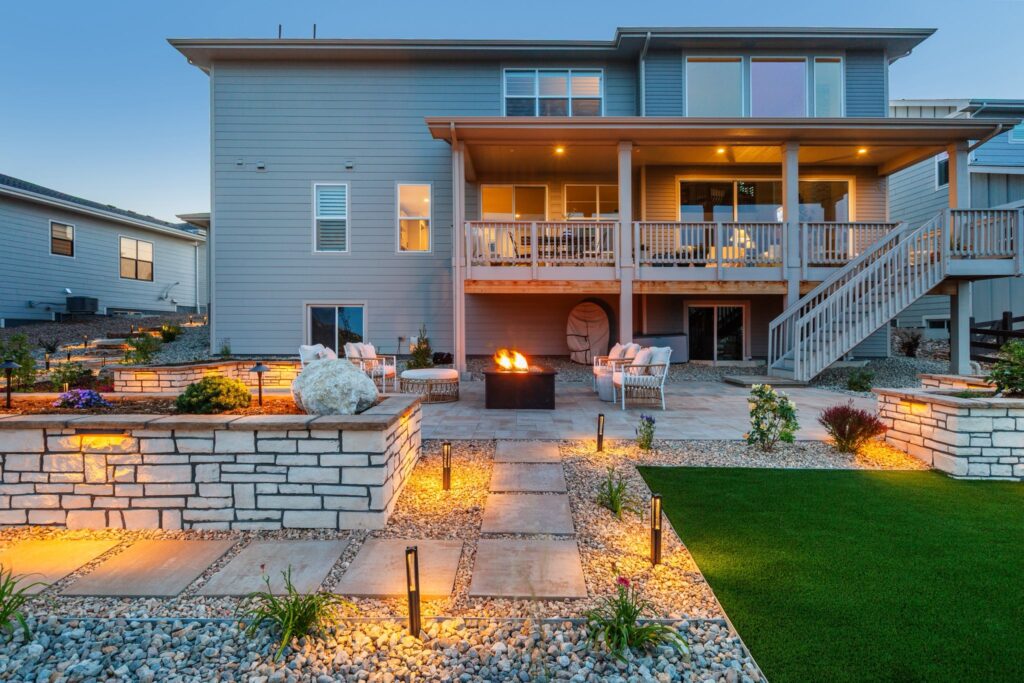
Modern backyard with stone pathways, illuminated landscaping, a central fire pit, outdoor seating, artificial turf, and a two-story house with a balcony and stairs in the background.You found the right home. Now build the right outdoor space to go with it.

The Front Range corridor from Colorado Springs north to Castle Rock is home to some of the most sought-after new construction neighborhoods in Colorado. Each community has its own character, its own draw, and its own reasons why families choose to put down roots there. What they share is this: a brand-new home that is finished inside and waiting on the outside.

AG Landscaping works with new construction homeowners throughout this entire corridor. We understand the soil conditions, the climate realities, the HOA expectations, and the project types that make sense at each price point and property size. We design and install paver patios, outdoor kitchens, fire features, pergolas, retaining walls, landscape lighting, water features, and planting plans — and we build everything to a standard that holds up in Colorado’s demanding climate.

Whether you just closed on a home in Colorado Springs’s northeast neighborhoods, purchased in a Monument new development, or built in Castle Rock’s foothills, the process starts the same way: a site visit, a conversation about how you want to use the space, and a design that fits your property, your family, and your budget.

What Every New Construction Homeowner Faces

Builder-grade yards have one thing in common regardless of neighborhood: they are a starting point, not a finished product. The grade has been established, the fence is up, and the rest is waiting. For most new homeowners, that means a yard that looks incomplete relative to the home they just invested in — and a list of questions about where to start.

The most common questions we hear from new construction clients across this entire corridor are consistent:

  • How do I create a patio that actually works for how we live — meals outside, fire in the evenings, kids in the yard?
  • What materials hold up in Colorado’s freeze-thaw cycles without requiring constant maintenance?
  • How do I get privacy without waiting ten years for trees to grow?
  • What should I do first, and what can wait until next year?
  • How do I avoid making expensive mistakes that have to be fixed later?

These are the right questions. The answers depend on the specific property, the neighborhood context, and the homeowner’s priorities — which is exactly why we start every engagement with a site visit rather than a price list.

What We Install for New Construction Homes

Paver Patios and Outdoor Living Areas

A well-designed paver patio is the foundation of every outdoor living space we build. We are certified Unilock contractors, which means we work with premium paver products and install to a manufacturer-specified standard that most local contractors do not follow. The difference shows up years later — in a patio that stays level, drains correctly, and requires no remediation — rather than immediately.
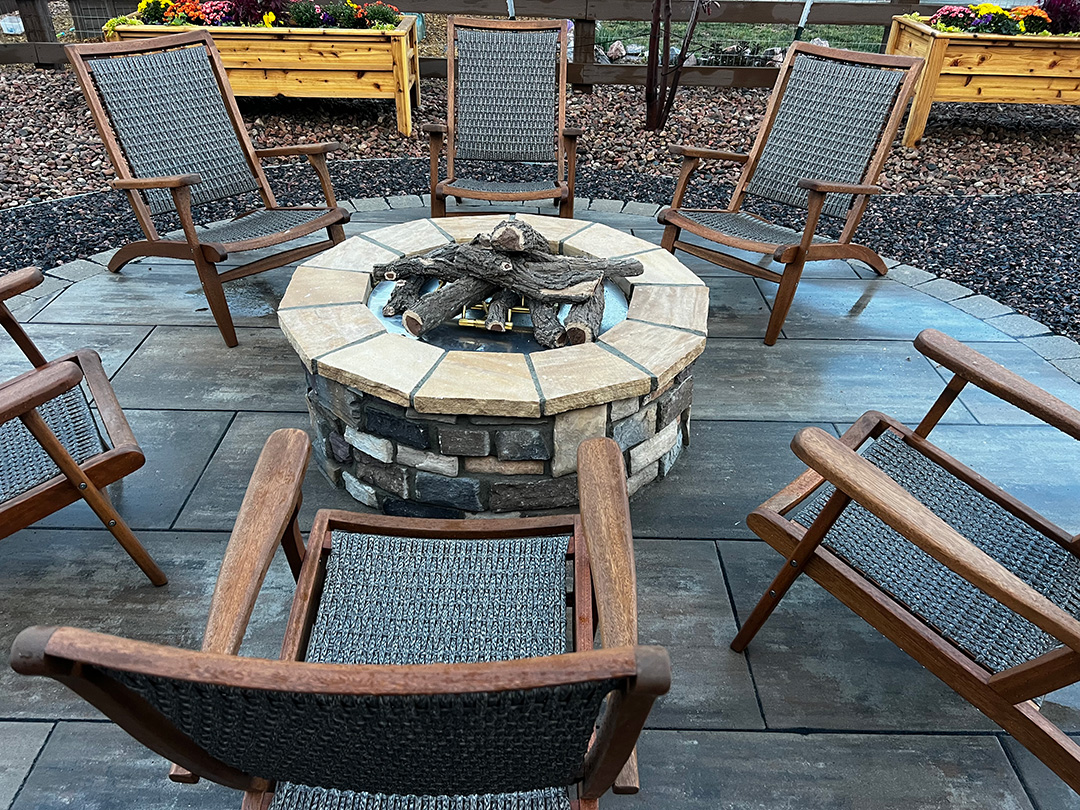
For new construction homes, we design patios with defined outdoor rooms: a primary seating area, a fire feature zone, a dining space if the yard allows, and clear transitions to the lawn. The goal is a patio that functions as an extension of the home’s interior, not as an afterthought attached to the back of the house.

We also install pedestal paver systems — a raised floating floor system that sits on adjustable support pedestals rather than a compacted base. Pedestal pavers drain freely beneath the surface by design, work on sloped or uneven substrates, and allow access to any utilities running beneath the patio. For new construction projects where utilities are still being established or drainage is a concern, the pedestal system is often the smartest long-term choice.
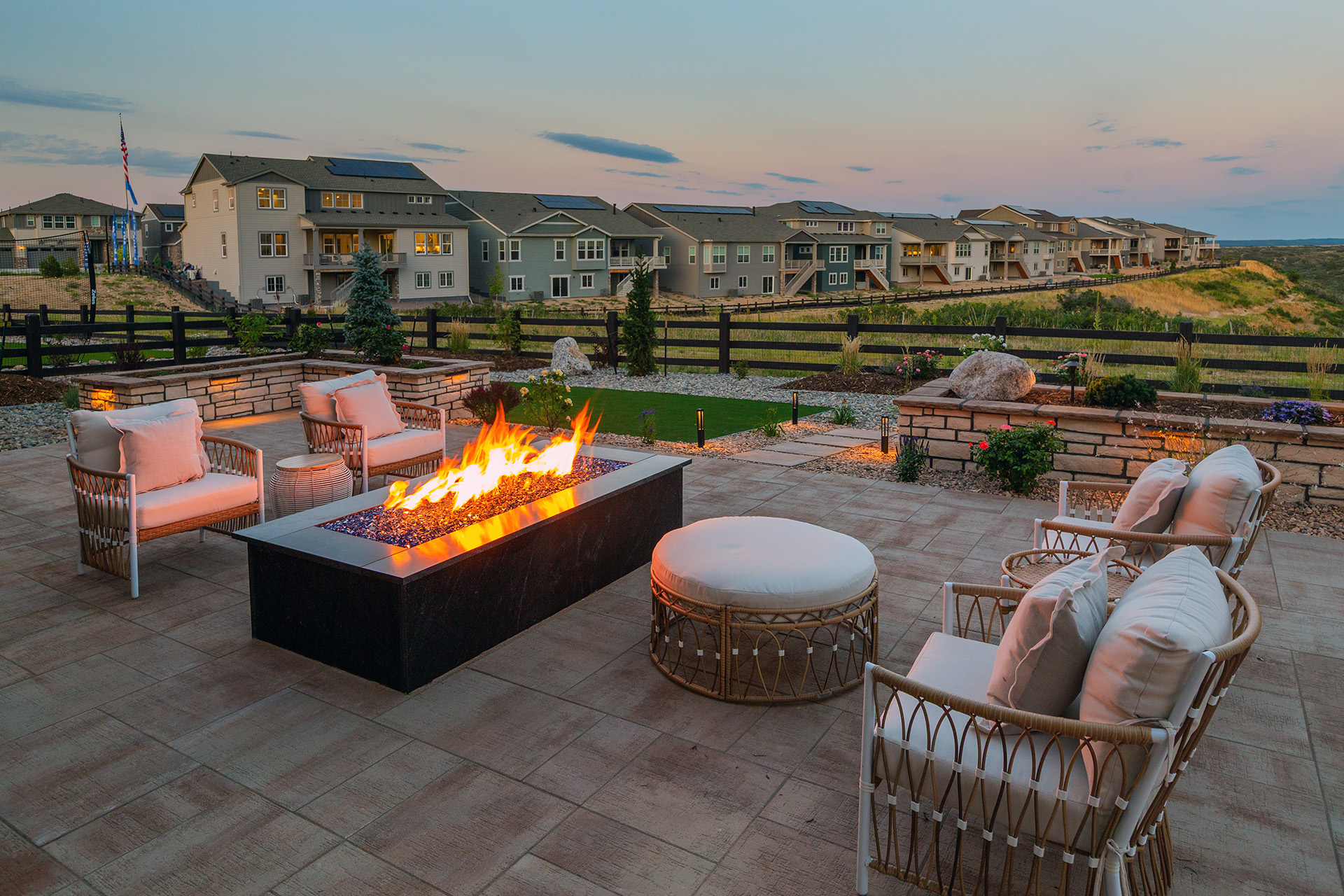
A modern outdoor patio with cushioned wicker chairs and a rectangular fire pit, overlooking houses and an open landscape at sunset.

Fire Features

A fire feature is the single element that most transforms how a family uses their outdoor space. It extends the season into shoulder months, creates the social gathering point that makes the patio feel intentional, and works at virtually every price point from a modest gas fire table to a built-in gas fireplace integrated into an outdoor kitchen surround.

We design fire features as part of the overall patio composition — positioned for the views, oriented away from the prevailing wind, sized appropriately for the seating arrangement, and finished with materials that connect to the rest of the hardscape. A fire feature that was designed into the space looks and functions differently than one that was placed wherever there was room.

Pergolas and Overhead Structure

Colorado’s 300-plus days of sunshine are one of the great selling points of the Front Range. They are also the reason afternoon shade matters. A well-designed pergola creates usable outdoor space during the hours when direct sun would otherwise push you back inside, and it creates the visual structure that makes a patio feel like a room rather than an open slab.

We build pergolas in cedar and steel, from straightforward open-beam structures to engineered systems with retractable shade elements. The right choice depends on the architecture of the home, the HOA guidelines of the community, and what the homeowner actually needs from the structure.
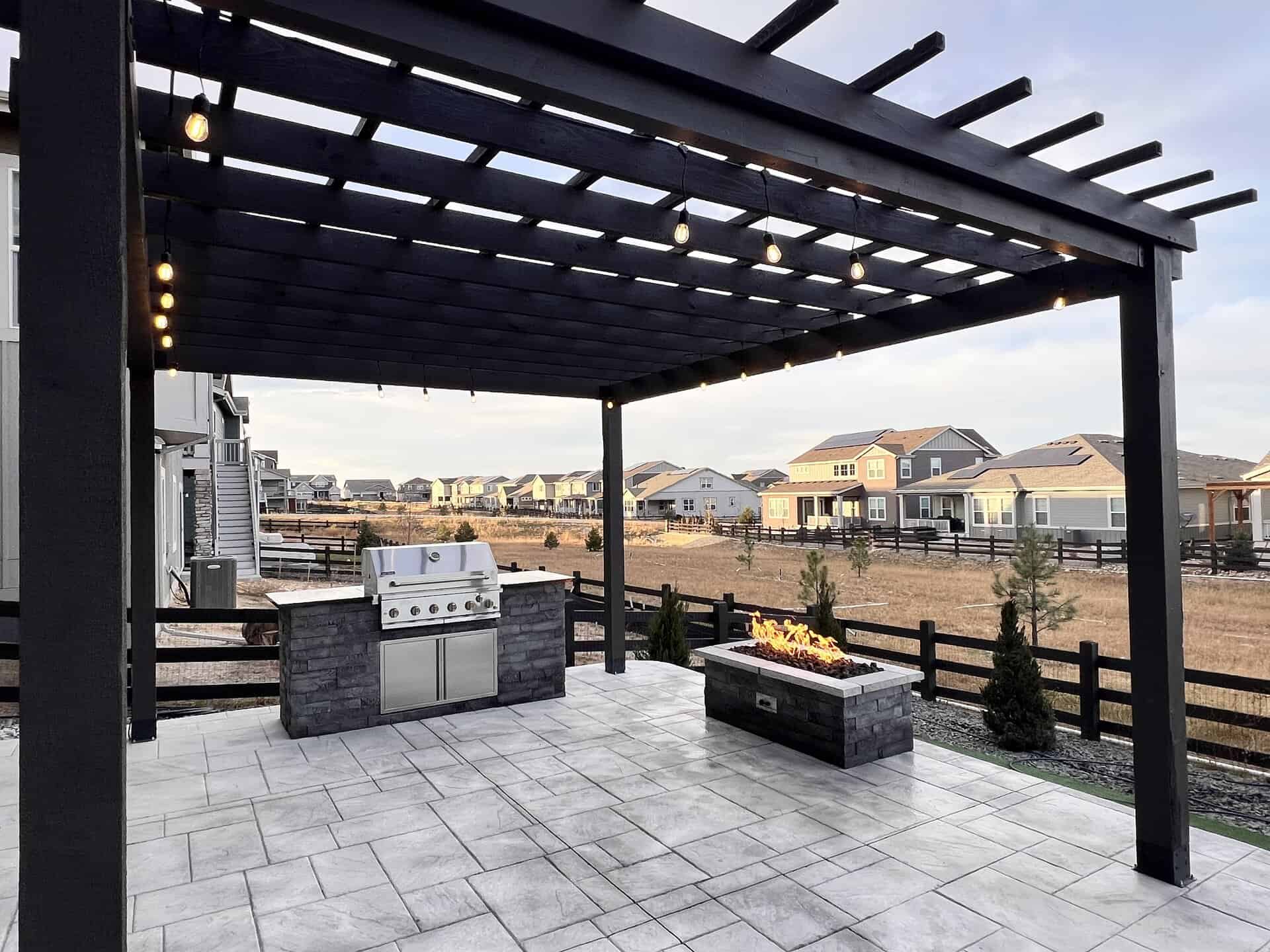
A modern outdoor patio with a pergola, built-in grill station, and rectangular fire pit; overlooking a suburban neighborhood and open field.
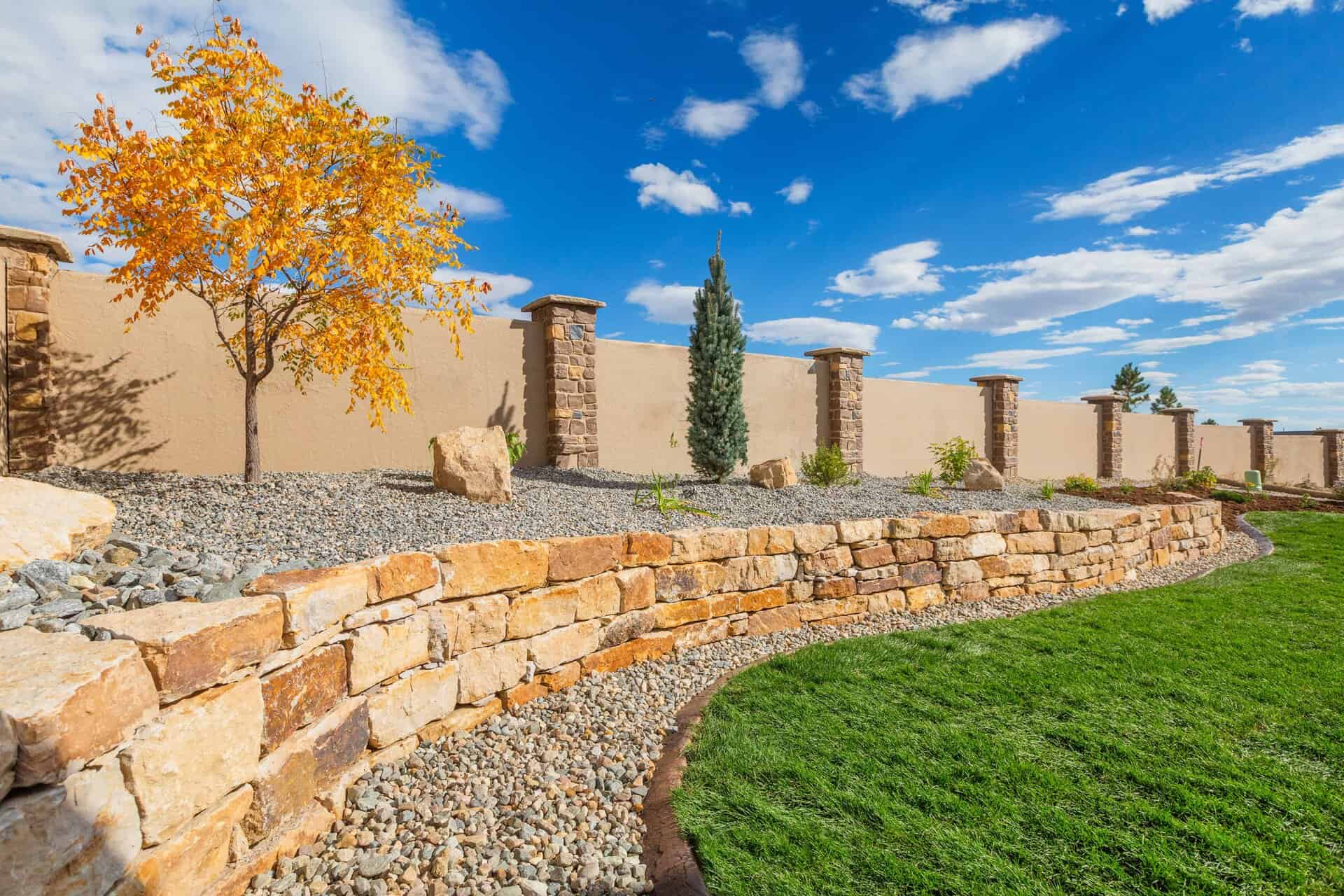
A landscaped backyard by a skilled landscaper features a stone retaining wall, gravel ground cover, a small tree with yellow leaves, and a green lawn under a blue sky with scattered clouds.

Retaining Walls

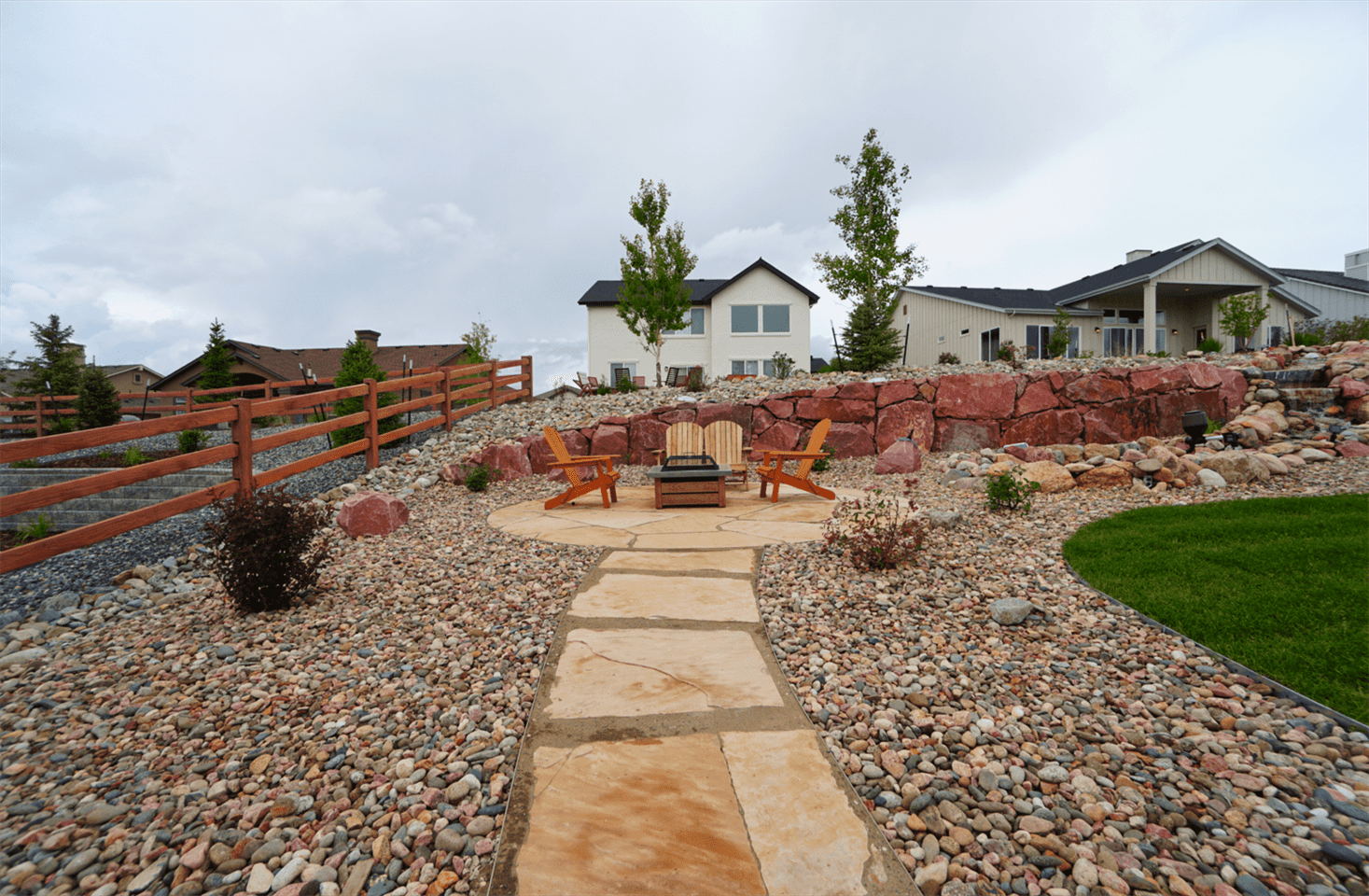
Many new construction lots in this corridor — particularly in the hillside neighborhoods of Monument, Palmer Lake, Castle Rock, and Castle Pines — have meaningful grade changes that require retaining walls to create usable yard space. We build retaining walls in boulder, block, and combination systems, always with proper drainage installed behind the wall.

Drainage is the most consistently skipped step in residential retaining wall construction and the primary reason walls fail. Hydrostatic pressure from water accumulating behind an undrained wall eventually moves the wall, regardless of how well the face was constructed. Every wall we build is drained correctly from the beginning.

Landscape Lighting

Outdoor lighting is the investment most new construction homeowners defer and most wish they had installed from day one. Running conduit and positioning fixtures before the planting beds are established and the sod is laid costs a fraction of what it costs to retrofit lighting two years later. We design lighting systems as part of the initial landscape plan — pathway lighting, uplighting on specimen trees and boulders, and accent lighting on structures — so the finished yard looks intentional after dark as well as during the day.
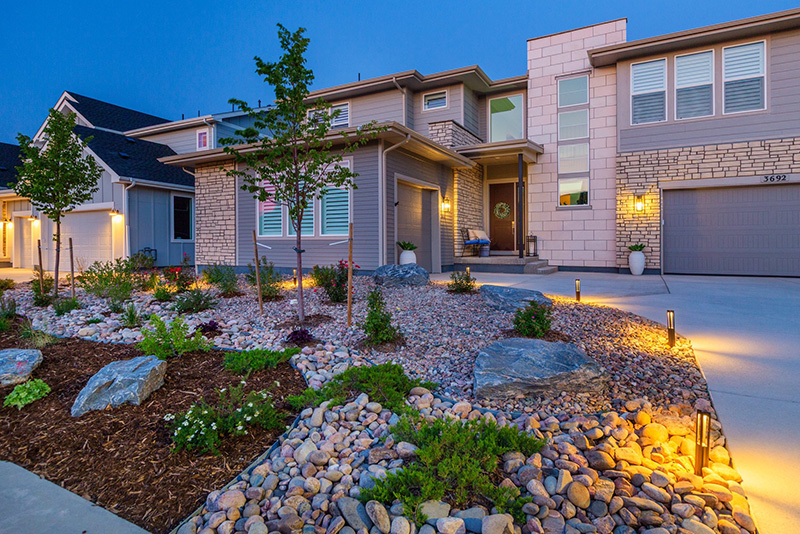
Modern two-story house with stone accents, landscaped front yard with rocks and small plants, illuminated by outdoor lighting at dusk.
Cabernet Landscape Project

Trees, Planting, and Privacy

The fastest way to make a new construction yard feel established is strategic tree placement. We consistently advocate for investing in larger-caliper specimens — trees that are already eight to ten feet tall at installation — rather than small seedlings that will take years to contribute to the design. In Colorado’s climate, where growth rates are measured in inches per year, the size difference at installation translates directly into years of waiting.

Privacy screening, ornamental grasses, flowering shrubs, and boulder placement all contribute to a yard that feels finished and three-dimensional rather than flat and exposed. The plant palette we use reflects the specific community, elevation, and soil conditions of each property.

Communities We Serve: Colorado Springs to Castle Rock

The communities along this corridor each have their own character — their own reasons why people choose to live there, their own landscape context, and their own expectations for what an outdoor living space should look and feel like. Here is how we think about each one.

Castle Rock

Douglas County’s anchor city — fast-growing, high investment, gateway to the mountains

Why people choose this area

Castle Rock is the largest and most economically active community in the southern Denver metro / northern Colorado Springs corridor, with significant commercial investment, excellent schools, and new construction activity that has been among the most vigorous in Colorado over the past decade. The namesake rock formation anchors the town visually, and the terrain transitions from open plains to rolling hills as you move west and south toward the foothills. New construction is concentrated in large master-planned communities including The Meadows, Terrain, Cobblestone Ranch, and Crystal Valley, with price points ranging from entry-level to high-end custom.

What new homeowners want in their landscape

Castle Rock homeowners are making a serious investment in a community they expect to grow and appreciate. Outdoor living spaces are part of that investment thesis — buyers understand that a well-executed patio, fire feature, and lighting system adds tangible value to a Castle Rock property. Younger families want functional, child-friendly yards with room to grow into. More established buyers want premium outdoor entertaining spaces with outdoor kitchens, pergolas, and fire features that support an active social lifestyle. The community’s mountain proximity makes fire features particularly popular — Castle Rock evenings are cool enough to enjoy a fire for most of the year.

Landscape design note

Castle Rock’s master-planned communities each have their own HOA standards and aesthetic expectations. Material selection and installation quality are important not just for the homeowner’s satisfaction but for community compliance. The rolling terrain in communities like Terrain and The Meadows creates natural opportunities for multi-level patios, retaining walls, and elevation changes that can become design assets with the right approach.

Parker

Established Douglas County suburb — family-oriented, growing, community-focused

Why people choose this area

Parker is one of Douglas County’s most established communities, with a downtown core, strong school reputation, and a family-oriented character that has made it consistently popular with buyers relocating from out of state and within the Denver metro. New construction continues in Parker’s outlying neighborhoods, though the community has a more established feel than the newer developments further south. Lots tend to be moderate in size — smaller than Falcon or Larkspur but larger than dense city infill — and the community’s mix of established trees and newer development gives it a more mature landscape character.

What new homeowners want in their landscape

Parker families want outdoor spaces that are genuinely functional for how they live — safe and accessible for children, designed for casual entertaining, and low enough maintenance that they can actually enjoy the yard rather than spending weekends managing it. Paver patios, fire features, pergolas, and well-designed lighting are consistently popular. Resale value is important to Parker buyers, who tend to move within the Denver metro and understand that outdoor living space has become a meaningful factor in home valuation.

Landscape design note

Parker’s more moderate climate compared to the higher-elevation foothills communities means a slightly broader plant palette is viable. The established neighborhood character also means mature trees may be present on adjacent properties, which influences privacy design — screening needs are often directional rather than perimeter-wide.

Castle Pines

Upscale Douglas County — golf course community, premium homes, high expectations

Why people choose this area

Castle Pines is one of the most affluent communities in Douglas County, anchored by the Castle Pines Golf Club and characterized by large homes, manicured streetscapes, and a strong sense of community identity. The terrain is rolling and wooded relative to the plains communities to the south, with ponderosa pine and scrub oak providing a naturalistic backdrop. HOA standards in Castle Pines are among the most comprehensive in the corridor — landscape and hardscape work is expected to meet a high bar for both quality and aesthetic consistency.

What new homeowners want in their landscape

Castle Pines homeowners expect premium materials, precise execution, and outdoor spaces that look like they belong to a high-end property. Unilock premium paver products, built-in outdoor kitchens, gas fire features, integrated lighting systems, and professional planting design are standard expectations rather than upgrades. Water features, pergolas, and multi-level patio designs are common at this price point. HOA review processes are part of the project timeline and require detailed documentation of materials and installation specifications.

Landscape design note

The wooded character of Castle Pines properties creates a naturalistic backdrop that premium landscape design should complement. Warm lighting tones, natural stone materials, and plant selections that transition between the formal patio and the native understory create spaces that feel connected to their setting rather than imposed on it.

Sedalia

Douglas County foothills — the rural fringe of the Denver metro’s southern reach

Why people choose this area

Sedalia sits just south of the metropolitan area’s practical reach, in the foothills west of Interstate 25 at the base of the Rampart Range’s northern extension. Like Larkspur and Franktown, it attracts buyers who want acreage, quiet, and genuine separation from suburban density. The landscape transitions quickly from open grassland to ponderosa pine hillside, and many properties have significant topographic variation. New construction is limited and typically custom.

What new homeowners want in their landscape

Sedalia homeowners value craftsmanship and durability in outdoor construction — they are investing in properties they intend to keep, and they want landscape and hardscape work that reflects that intention. Retaining walls that manage the topographic variation, outdoor living areas that work with the site rather than against it, and lighting that complements rather than overpowers the natural dark-sky environment are consistent priorities.

Landscape design note

Topographic variation in Sedalia creates both challenges and opportunities for landscape design. Grade changes that require retaining walls also create the elevated patios, terraced planting areas, and multi-level outdoor spaces that make hillside properties so compelling. Work with the grade rather than flattening it.

Franktown

Open countryside between corridors — Douglas County’s quiet residential landscape

Why people choose this area

Franktown is a small unincorporated community in Douglas County, sitting at the crossroads of State Highway 83 and State Highway 86 on the open plains-to-foothills transition. It is not a destination in the way that Castle Rock or Monument are — it is a place people choose specifically because it is not a destination. Properties tend to be large, the pace is quiet, and the buyer profile skews toward people who have intentionally sought distance from suburban density. New construction is limited and typically custom or semi-custom.

What new homeowners want in their landscape

Franktown buyers are self-selecting for independence and space. Their landscape priorities tend toward functionality and authenticity over trend: well-built outdoor structures that last, plant selections that are genuinely adapted to the high plains environment, and outdoor living areas designed for how the family actually lives rather than how the neighborhood expects them to present.

Landscape design note

Wind is a significant factor in Franktown’s open terrain. Fire feature and pergola placement should account for the prevailing southwest-to-northeast wind pattern. Drought-tolerant and wind-tolerant plant selections are essential at this exposure.

Larkspur

Rural foothills living — horses, acreage, and genuine distance from the city

Why people choose this area

Larkspur occupies the transition zone between the Colorado Springs metro and the Denver exurbs, at elevations ranging from 6,500 to 7,500 feet through a mix of meadows, ponderosa forest, and rocky ridgelines. It is horse country and acreage country — buyers here typically have more land than any other community in the corridor, and many are specifically seeking properties where animals are welcome and neighbors are not visible from the kitchen window. The Douglas County portion of Larkspur has seen some new construction activity, but the dominant character is established rural residential rather than master-planned development.

What new homeowners want in their landscape

Larkspur homeowners with acreage want landscapes that work at scale without requiring intensive maintenance — drought-tolerant plant palettes, natural stone hardscape, and outdoor living areas designed around the specific topography of the property rather than imposed on it. Functionality matters: a fire feature that works on windy ridge evenings, a patio surface that handles the freeze-thaw at 7,000 feet, lighting that is effective without being intrusive in a dark-sky environment.

Landscape design note

Acreage properties in Larkspur often have natural rock outcroppings, mature ponderosa pines, and existing grade features that should be worked with rather than removed. Landscape design that incorporates the natural character of the site reads as authentic and ages well.

Palmer Lake

Small mountain town with genuine character — the gateway to the mountains

Why people choose this area

Palmer Lake is one of the smallest and most distinctive communities in the corridor. The town sits at the base of the Rampart Range, centered on a small lake that gives the town its name, with a historic downtown and a genuine sense of community identity that is rare in rapidly growing areas. New construction in Palmer Lake is limited compared to the larger communities — the town’s geography and character constrain large-scale development — which means new homeowners here are typically building or buying in smaller infill developments or custom-lot situations. Buyers choose Palmer Lake for its authenticity, its trail access, its proximity to nature, and its resistance to becoming something it is not.

What new homeowners want in their landscape

Palmer Lake homeowners tend to want landscapes that honor the mountain character of their surroundings rather than imposing a suburban aesthetic onto a genuinely natural setting. Native plant palettes, natural stone, and understated hardscape that complements the landscape rather than dominating it are consistent priorities. Water features work particularly well here given the town’s relationship with its namesake lake.

Landscape design note

The natural aesthetic that Palmer Lake homeowners prefer aligns well with boulder retaining walls, flagstone pathways, and native plant-forward planting plans. Lighting should be low-key and warm — Palmer Lake is dark-sky friendly and overlighting a property would feel out of character with the community.

Monument

Foothills character at 7,000 feet — mountain lifestyle, excellent schools, growing fast

Why people choose this area

Monument sits at roughly 7,000 feet elevation in the foothills between Colorado Springs and Castle Rock, with a climate that feels meaningfully different from either city. Winters are longer, the growing season is compressed, and the landscape shifts from plains to ponderosa pine forest as you move up the hillsides. Monument has grown rapidly over the past decade, with new developments expanding through Jackson Creek, Forest Lakes, and along the Highway 105 corridor. Buyers choose Monument for its small-town character, highly rated schools, mountain proximity, and a quality of life that combines suburban amenity with genuine foothills character.

What new homeowners want in their landscape

Monument new construction buyers are investing in a lifestyle — morning coffee with mountain views, evenings around a fire, a yard that reflects the natural beauty of the surrounding landscape rather than fighting against it. They want outdoor spaces that feel at home in the foothills: natural stone, warm lighting, fire features scaled to the cooler evenings, and plant selections that belong in a 7,000-foot environment. Privacy from neighboring lots in the denser developments is a consistent priority.

Landscape design note

Freeze-thaw cycles are more pronounced in Monument than in Colorado Springs. Proper base preparation for any paver installation is non-negotiable at this elevation. Plant selection should reflect the compressed growing season — native and near-native species that are already adapted to the climate outperform exotic plantings that may look good at a nursery but struggle through Monument winters.

Falcon & Peyton

Eastern plains — larger lots, semi-rural character, room to build something real

Why people choose this area

Falcon and the adjacent Peyton area attract buyers who want more space than closer-in neighborhoods can offer — larger lots, more distance between neighbors, and a quieter, semi-rural quality of life without being far from Colorado Springs amenities. New construction in Falcon is concentrated in planned communities along Woodmen Road and Highway 24, with lot sizes that frequently exceed a quarter acre. The elevation is somewhat lower than the city, the terrain is flat to gently rolling, and the views to the west — Pikes Peak framed against the Front Range — are consistently dramatic.

What new homeowners want in their landscape

Falcon and Peyton homeowners typically have more outdoor square footage to work with than urban buyers, which means larger patio footprints, more ambitious planting plans, and room for features that simply do not fit on a smaller lot — outdoor kitchens, water features, larger fire areas, extensive privacy planting along long fence lines. Wind is a meaningful factor on the eastern plains, and buyers who have lived here for a season know it — they want fire features and pergolas designed with wind exposure in mind.

Landscape design note

Large-format patios (800–1,500+ sq ft) are common in Falcon. The flat terrain is well-suited for pedestal paver systems that manage drainage across large surfaces. Tree selection should prioritize wind tolerance alongside aesthetics — Austrian pine, ponderosa pine, and native scrub species perform well here.

Colorado Springs

The region’s anchor city — diverse neighborhoods, military community, established amenities

Why people choose this area

Colorado Springs attracts a wide range of buyers, from military families stationed at Fort Carson, Peterson, Schriever, or the Air Force Academy to civilian professionals drawn by the tech sector, healthcare industry, and quality of life. New construction is concentrated in the northeast (Banning Lewis Ranch, Wolf Ranch, Cordera, Norwood) and the northwest (Flying Horse, Gleneagle), with each submarket having its own price point and character. The city’s elevation of roughly 6,000 feet means four distinct seasons, strong UV exposure, and enough freeze-thaw action in spring to matter for hardscape installation.

What new homeowners want in their landscape

Colorado Springs new construction buyers typically want outdoor living spaces that are functional year-round rather than seasonal. Fire features, covered pergolas, and well-lit patios are priorities. Military families, who tend to move frequently and think carefully about resale, want upgrades that photograph well and add demonstrable value. Buyers in the Flying Horse and Cordera neighborhoods want premium materials and polished finishes that match the community’s HOA standards.

Landscape design note

HOA compliance is important in many Colorado Springs new construction communities. Material selection, fence heights, and installation quality are all visible to neighbors and reviewers. We design to meet community standards while creating spaces that feel personal rather than generic.

How We Work With New Construction Homeowners

Every engagement starts with a site visit. We come to the property, walk the yard with you, and talk through what you want to use the space for — not what you think you are supposed to want, but how you actually intend to live out there. From that conversation, we develop a design that fits the property, respects the community context, and builds toward the outdoor space you actually want.

We are transparent about phasing. Not every homeowner wants to invest in everything at once, and a well-phased landscape that installs the patio and fire feature in year one, adds the planting and lighting in year two, and finishes the perimeter in year three is a legitimate strategy. What matters is that each phase builds coherently toward the complete vision rather than requiring rework to accommodate what comes next.

We build to last. Proper base preparation, correct drainage, certified installation standards, and quality materials are not optional elements that get value-engineered out when the budget gets tight. They are the reason our projects look good five years after installation instead of requiring remediation.

Ready to Start the Conversation?

AG Landscaping serves new construction homeowners from Colorado Springs to Castle Rock and throughout the communities in between. If you have recently moved into a new home and are ready to design your outdoor space, we would be glad to meet you at the property. Request a free consultation — there is no obligation, and the site visit is always worth having.