Hardscape design in Colorado Springs is the planning and layout of the solid, built parts of a yard: patios, fire pits, stone walls, retaining walls, and walkways, arranged so they work together instead of feeling like separate projects bolted onto a lawn. A good design accounts for our soil, our slopes, and our freeze-thaw winters before a single paver goes down, which is exactly where a lot of yards in this area run into trouble. This guide covers what hardscape design involves, what to expect from a contractor, and how patios, fire pits, and everything else come together into a yard you’ll actually use.
Hardscape Design: What It Covers and Why It Matters
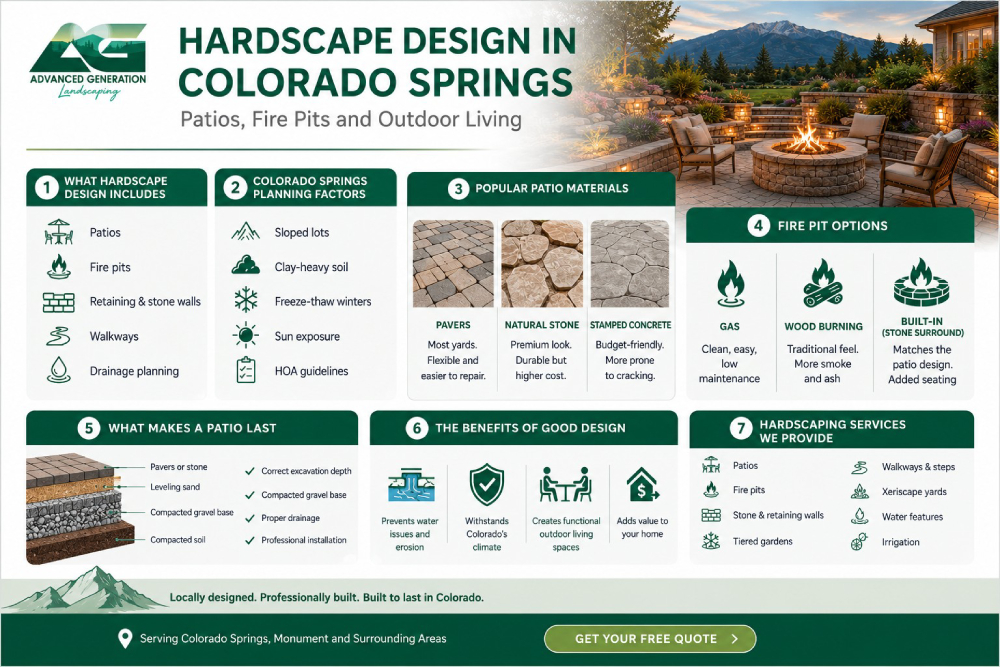
When people hear “hardscape,” they usually think of a patio. Really, hardscape design covers every hard, permanent feature in a yard: patios, fire pits, retaining walls, stone walls, tiered gardens, walkways, and the drainage tying it all together. Softscape, by contrast, is the plants, grass, and mulch. Hardscape is what determines how the space actually functions, where people walk, where they sit, and whether the yard holds up through a Colorado winter.
This matters more here than in a lot of other places. Colorado Springs sits at altitude with clay-heavy soil in a lot of neighborhoods, sloped lots that are common from Broadmoor to Black Forest, and a freeze-thaw cycle that’s hard on anything installed without a proper base. A design that looks great on paper can crack, heave, or wash out within a year or two if it wasn’t planned around those conditions. Planning is cheaper than fixing a patio that’s already in the ground.
Planning Your Yard: Where Good Hardscaping Starts
Good hardscaping in Colorado Springs starts with how you actually use your yard, not with a list of features you’d like to have. Before any layout gets drawn, it helps to answer a few questions:
- How many people usually gather back there, and how often?
- Is this mostly for quiet evenings, or for hosting?
- Does the yard slope toward the house, away from it, or somewhere awkward in between?
- Is there a spot that stays shaded, or one that bakes all afternoon?
From there, we assess the site itself: soil type, drainage, existing grade, sun exposure, and any HOA rules that might affect materials or placement. A lot of Colorado Springs neighborhoods have specific guidelines on fence heights, wall materials, or paver colors, so we check that early, before a design gets finalized rather than after. A steeply sloped backyard in Cedar Heights needs a different approach than a flat lot in Wolf Ranch, even if both homeowners want the same paver patio and fire pit, and we plan for that difference from the start.
Choosing a Hardscape Contractor in Colorado Springs
As a hardscape contractor in Colorado Springs, we talk soil type, drainage, and freeze-thaw behavior with every homeowner before we talk pavers, because that’s what actually determines whether a patio or wall holds up here. It’s also the fastest way to spot the difference between a crew that installs hardscape anywhere and one that understands what this region does to a poorly built patio or wall.
Here’s what we make sure every homeowner knows before we start:
- How deep the base goes, and what it’s made of. A shallow base is the top reason patios heave after a hard winter, so we never cut corners here.
- Our drainage plan. Water needs somewhere to go that isn’t against your foundation, and we map that out before installation starts.
- We handle design and installation together. The same team that plans your layout is the one setting the base and laying the stone, so site issues get caught early instead of turning into change orders.
- Work we’ve completed nearby, ideally a few winters old. We’re happy to show you projects that have already been through a Colorado Springs winter or two, not just fresh photos.
AG Landscaping builds hardscape projects across Colorado Springs and out toward Monument, and we handle both the design and the build on every one of them.
Patio Design: Picking a Layout and Material That Fits Your Yard
Patio design in Colorado Springs comes down to matching layout and material to how the space will be used and the conditions it has to survive. Shape and size should follow function first. A dining and grill setup needs different proportions than a fire pit and a couple of lounge chairs.
Material choice matters just as much, and it’s often the hardest decision to make without seeing the options side by side:
| Material | Best for | How it handles our winters |
|---|---|---|
| Pavers | Most yards, patterns, and repairs | Individual units shift slightly with the ground instead of cracking; the most forgiving option here |
| Natural stone | Custom, upscale looks | Holds up well but costs more and needs careful setting |
| Stamped concrete | Simple layouts, tighter budgets | Prone to cracking if the base wasn’t prepped for our soil |
Color matters too. A lighter paver reflects more summer heat, while a darker one holds warmth into the evening. These are small details that change how comfortable a patio feels depending on which direction it faces.
Inside a Custom Patio Installation, Base to Finished Surface
Custom patio installation in Colorado Springs involves a lot more happening underground than most homeowners expect:
- Excavation to the correct depth
- A compacted gravel base
- A layer of sand for leveling
- Pavers or stone set on top, with joint sand swept into the gaps
The base is genuinely what determines whether a patio lasts fifteen years or starts heaving after two winters. Skipping depth or compaction is invisible on installation day and obvious by the second spring, once frost has worked on a base that wasn’t packed properly.
Timeline-wise, a straightforward patio might take a few days from excavation to finished joints. A larger custom design with multiple levels, a built-in fire pit, or a tie-in to an existing walkway can run one to two weeks, with weather playing a role in scheduling either way.
Gas, Wood, or Built-In: Picking the Right Fire Pit for Your Yard
Fire pit installation in Colorado Springs usually comes down to gas versus wood burning, and that choice affects both design and upkeep.
| Type | Pros | Trade-offs |
|---|---|---|
| Gas | Instant light, no smoke or ash, easy to place close to seating | Needs a gas line run during the design phase |
| Wood burning | Traditional feel, no gas line needed | More clearance needed, ash cleanup, local burn restrictions can apply |
| Built-in (stone surround) | Matches the patio, doubles as extra seating | Costs more, needs to be planned with the patio layout |
Placement matters as much as type. Wind patterns, seating distance, and proximity to the house or fence all factor into where a fire pit should go, not just where it looks good on paper.
How Outdoor Living Design Ties Your Patio, Fire Pit, and Walkways Together
Outdoor living design in Colorado Springs connects a patio, fire pit, walkway, and any walls or gardens into one space that flows, instead of a handful of features scattered around a yard. This is where piecemeal projects fall short.
A patio poured one year, a fire pit added the next, and a wall put in a few years later often ends up feeling like three separate decisions rather than one yard, especially when three different crews touched it along the way.
We handle it all under one roof, so a cohesive design usually groups a main gathering area, a transition space like a walkway or steps, and supporting elements like retaining walls or tiered beds where the lot has any grade change.
Lighting threads through all of it too, since even a well-designed patio goes dark and unused after sunset without a plan for path or accent lighting, and we build that in from the start rather than treating it as an afterthought.
What AG’s Hardscaping Services Cover, From Patios to Retaining Walls
AG Landscaping provides hardscaping services in Colorado Springs covering:
- Patios and fire pits
- Stone walls and retaining walls
- Tiered gardens and xeriscape yards
- Water features and irrigation systems
Working with one team across all of it means the patio, the wall holding back a slope, and the fire pit sitting on top of it get designed and built with each other in mind, rather than as separate jobs from separate crews that never quite line up.
That matters most on Colorado Springs lots with any real grade change, which is a lot of them. A retaining wall built without the patio in mind can end up at the wrong height or without proper drainage behind it, problems that show up as standing water or a leaning wall a couple of years later. If you’re weighing where to start, the patio is usually the right call, since it anchors the fire pit, walkway, and seating that go around it.
Frequently Asked Questions
Start Your Hardscape Design
A hardscape design in Colorado Springs that’s planned around your actual yard, rather than a generic layout, is the difference between a patio that needs repairs in three years and one that still looks right in fifteen. AG Landscaping can walk your property, talk through what fits your lot and your budget, and put together a plan that covers everything from the patio underfoot to the fire pit at the center of it.